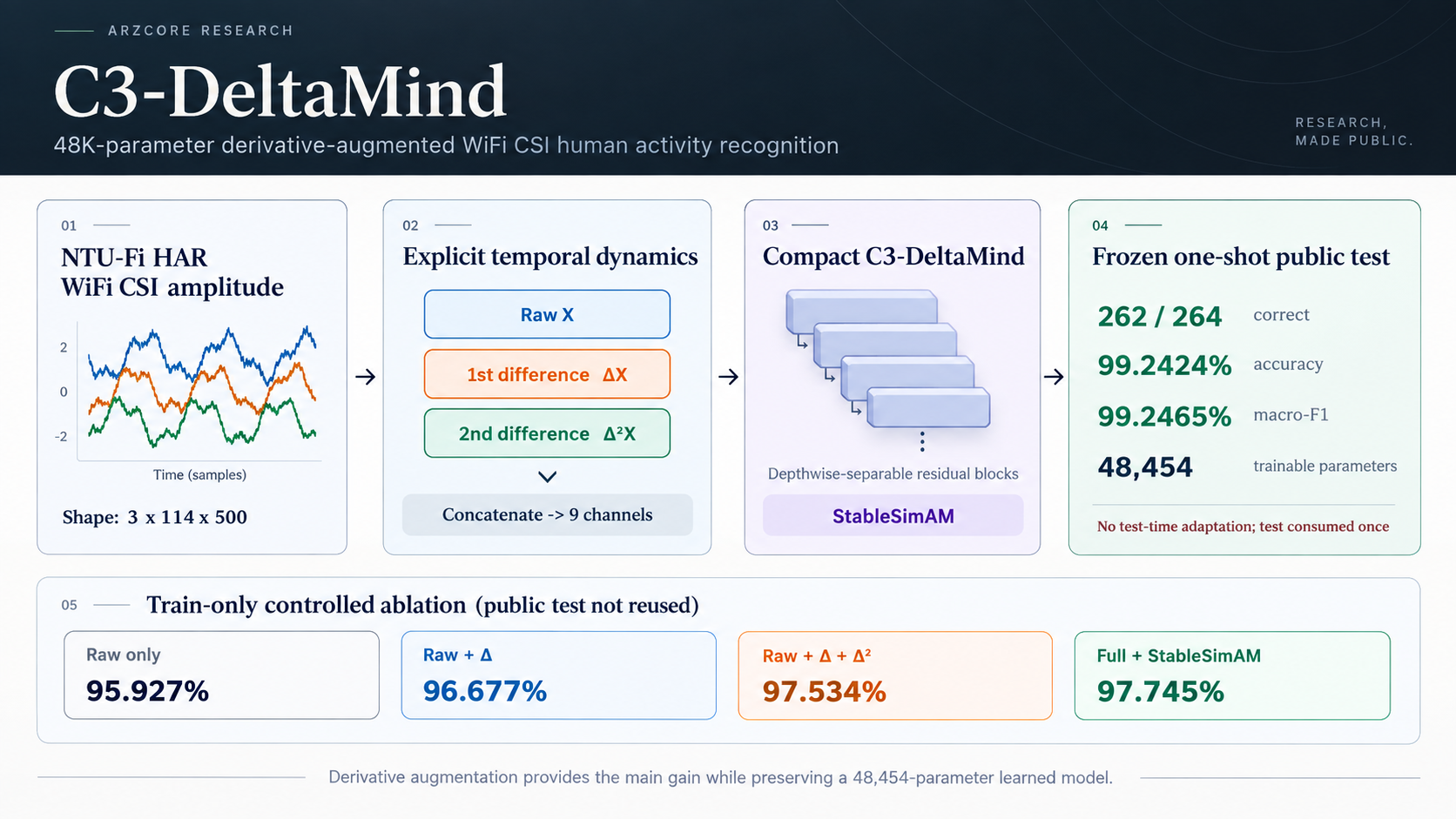
The final model was frozen before the predefined public test was accessed, then evaluated once after the train-integrity gate and permanent consumption lock were established.
48,454Trainable parameters
99.2424%Test accuracy
99.2465%Macro-F1
262 / 264Correct classifications
97.7778%Minimum class F1
Research overview
Raw CSI, then Δ and Δ².
Explicit temporal differencing exposes motion-related changes before compact learned filtering. StableSimAM adds parameter-free attention after the depthwise-separable residual blocks.
Graphical abstract from the submitted manuscript.
Abstract
The paper, in one view.
Exact abstract from the submitted author manuscript.
Abstract — WiFi channel state information (CSI) enables device-free human activity recognition (HAR), but strong benchmark accuracy is often obtained with models that are unnecessarily large for resource-constrained sensing. This paper presents C3-DeltaMind, a 48,454-parameter network that explicitly stacks normalized CSI amplitude, first temporal differences, and second temporal differences before compact depthwise-separable processing with parameter-free StableSimAM attention. On the predefined NTU-Fi HAR split, the frozen model was retrained on all 936 training samples and evaluated once on the 264-sample public test after a train-integrity gate and a permanent consumption lock were established. The model correctly classified 262/264 samples, achieving 99.2424% accuracy, 99.2465% macro-F1, and 97.7778% minimum class F1. A post-final train-only controlled ablation using five acquisition-order blocked folds and equal 48,454-parameter variants increased mean accuracy from 95.927% for raw CSI alone to 96.677% with the first temporal difference, 97.534% after adding the second difference, and 97.745% for the complete model. The results support explicit temporal differencing as the main architectural contribution while preserving a small learned parameter budget. The paper also documents the frozen training recipe, test-set governance, hashes, and limitations needed for reproducible interpretation.
Architecture
Deterministic features. Compact learning.
The input starts with normalized CSI amplitude and explicit first- and second-order temporal differences, producing nine channels before compact spatiotemporal processing.
01 / Input
Normalized raw CSI
Processed NTU-Fi HAR amplitude representation.
02 / Dynamics
Δ + Δ²
First and second temporal differences are formed explicitly.
03 / Channels
9-channel stack
Raw, first-difference, and second-difference groups are concatenated.
04 / Core
Depthwise-separable residual network
Compact spatiotemporal filtering with 48,454 trainable parameters.
05 / Attention
StableSimAM
Numerically stabilized, parameter-free SimAM attention before classification.
Controlled ablation
The derivatives carry the main gain.
Train-only blocked validation performed after the public final was consumed. These numbers are not the 99.2424% locked public-test result.
Raw CSI
95.927%
Raw + Δ
96.677%
Raw + Δ + Δ², no StableSimAM
97.534%
Full C3-DeltaMind
97.745%
Mean train-only blocked-fold accuracy increased from 95.927% with raw CSI alone to 97.534% after both temporal differences; StableSimAM added a smaller average gain to 97.745%.
Evaluation protocol
Leakage-aware one-shot public evaluation
Predefined NTU-Fi HAR split: 936 training samples and 264 public-test samples.
Model configuration, seed, and epoch were frozen before public-test access.
A train-integrity gate was required before test enumeration/loading.
The final public test was consumed once; no test-time adaptation was used.
Reproducibility & integrity
Evidence without overclaiming
Frozen training recipe and cryptographic hashes are documented in the manuscript and supplementary material.
The source repository remains private pending publication and IP review.
Embedded latency, peak RAM, energy, and quantized accuracy were not measured for this exact 48K NTU-Fi model.
The paper makes a parameter-efficiency claim, not a universal accuracy-SOTA claim.
Publication status
Public preprint, peer review ongoing.
The public version is clearly separated from the journal decision. No DOI, arXiv identifier, acceptance, or IEEE publication status is claimed here.
05 Sep 2026Submitted
Initial manuscript submitted to IEEE Sensors Journal.
12 Sep 2026Public preprint
Author preprint made publicly accessible through ArzCore Research.
CurrentPeer review
Editorial and peer-review process in progress. No acceptance claimed.
Citation
Reference the public preprint.
Until an arXiv identifier or journal DOI exists, cite this version as a September 2026 preprint.
Osman Akkawi, “C3-DeltaMind: A 48K-Parameter Derivative-Augmented Network for WiFi CSI Human Activity Recognition,” preprint, September 2026.
About the author
Osman Akkawi
Computer Science / Information Technology, City University, Tripoli, Lebanon. Research interests include AI, machine learning, Edge AI, WiFi CSI sensing, signal processing, and embedded intelligence.